Let \(K\) be a field of characteristic 0. Let \(R\) be a \(K\)-algebra. Let us denote by \(\Omega_{R/K}\) the module of Kähler differentials, i.e.
\begin{equation*}
\Omega_{R/K} = \frac{\text{free module on } dr \,(r \in R)}{\left\langle dr \,(r \in K), d(r + s) - dr - ds, d(rs) - s\,dr - r\,ds \right\rangle}.
\end{equation*}
This admits a \(K\)-linear derivation \(d\colon R \to \Omega_{R/K}\) given by \(r \mapsto dr\) and is universal in the sense that if \(M\) is an \(R\)-module and \(\delta\colon R \to M\) is a \(K\)-linear derivation, then \(\delta\) factors uniquely as
\begin{equation*}
R \to \Omega_{R/K} \to M
\end{equation*}
where the map on the right is \(R\)-linear and the map on the left is \(d\text{.}\)
By the previous example, If \(R\) is a finite type \(K\)-algebra, then \(\Omega_{R/K}\) is a finite \(R\)-module. When \(R\) is a smooth \(K\)-algebra of dimension \(n,\) then \(\Omega_{R/K}\) is finite and locally free of rank \(n.\) The converse is also true by the Jacobian criterion. Similarly, if \(X\) is a scheme of finite type over \(K\text{,}\)\(\Omega_{X/K}\) is coherent; if \(X\) is smooth over \(K\text{,}\) then \(\Omega_{X/K}\) is locally free.
For \(i \geq 1,\) we define \(\Omega_{R/K}^i := \wedge_R^i\Omega_{R/K}\text{.}\) That is, \(\Omega_{R/K}^i\) is the free \(R\)-module on symbols \(\omega_1\wedge \cdots \wedge\omega_i\) with \(\omega_j \in \Omega_{R/K}\text{,}\) modulo relations of the form
One checks that \(d^{i + 1}\circ d^i = 0\text{,}\) so the \(\Omega_{R/K}^i\) form a \(K\)-linear complex, called the de Rham complex of \(R/K\text{.}\)
How do we make sense of the “cohomology” of \(\Omega_{X/K}^\bullet\text{?}\) The correct notion is that of hypercohomology. In fancy terms, this means viewing the complex as an object in the (bounded) derived category of abelian sheaves on \(X\text{,}\) then taking the derived global sections functor. (Beware that while the individual terms of the complex are quasicoherent sheaves, the morphisms are only \(K\)-linear, not \(X\)-linear.) In concrete terms, it is computed as follows.
For simplicity, let us assume that \(X\) is separated. Let \(\{U_i\}\) be a cover of \(X\) by open affines; our condition that \(X\) is separated means that any intersection among the \(U_i\) is again affine. Define the double complex
with the \(j\)-differentials being the Čech differentials and the \(k\)-differentials being the de Rham differentials. Then form the associated total complex, whose \(i\)-th term is \(\bigoplus_{j + k = i} D^{j, k}\) (with appropriate signs on the differentials to make this a complex), and take the cohomology to obtain \(\HH^i(X, \Omega^\bullet_{X/K})\text{.}\)
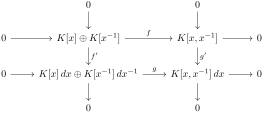
Here \(f\) is surjective with kernel \(K\text{;}\)\(f'\) is surjective with kernel \(K \oplus K\text{;}\)\(g\) is injective and the cokernel is generated by \(x^{-1}\,dx\text{;}\) and \(\ker(g') = K\) and \(\coker(g') = Kx^{-1}\,dx\text{.}\) Keeping in mind that \(dx^{-1} = -x^{-2}\,dx\text{,}\) we find that
Suppose \(X\) is a smooth projective (or proper) variety over \(\CC.\) Then there is a natural isomorphism \(\HH^i(X, \Omega_{X/\CC}^\bullet) \to H^i(X^{\analytic}, \CC)\) where \(X^{\analytic}\) denotes the associated complex analytic variety (analytification of \(X\)).
We can also define \(\Omega_{X/k}^\bullet\) and \(\HH^\bullet(X, \Omega_{X/k}^\bullet)\) when \(k\) is of characteristic \(p\text{,}\) but this can behave in unexpected ways. For example, if \(X/k\) is smooth and proper, \(\HH^\bullet(X, \Omega_{X/k}^\bullet)\) is finite dimensional over \(k\) (because it can be computed in terms of the coherent cohomology groups of the individual terms of the complex), but can be of the “wrong dimension.” Such phenomena can mostly be explained in terms of failure of degeneration of the Hodge–de Rham spectral sequence; this gives yet another way to identify varieties which cannot be lifted to characteristic 0 (Remark 2.0.7).