Chapter 15 Étale local systems
Original lecture date: November 25, 2019.
In this lecture, we turn back to étale cohomology and introduce the notion of an étale local system.
Readings 15.0.1.
The (profinite) étale fundamental group is introduced in SGA 1 [61].
Section 15.1 The étale fundamental group
First we cover the étale fundamental group. Its definition is motivated by the fact that in algebraic geometry, universal covers don't have a good equivalent, but finite covering space maps correspond to finite étale morphisms.
Definition 15.1.1.
Let \(X\) be a connected scheme and \(x \in X\) a geometric point, i.e., a map
where \(\overline{k}\) is an algebraically closed field. (In fact we could even take \(\overline{k}\) to be only separably closed, but never mind about that here.) To this data, one then attach a profinite fundamental group \(\pi_1(X,x)\) the profinite (étale) fundamental group of \(X\) with basepoint \(x\). This has the following properties.
-
If \(y \to X\) is another geometric point of \(X\text{,}\) then \(\pi_1(X,x) \cong \pi_1(X,y)\) via an isomorphism which is well-defined up to conjugation. This parallels the topological case, in which such isomorphisms are paths joining the two basepoints, and two different paths give isomorphisms differing by conjugation by the loop formed by the two paths.
This also parallels Galois theory. Fixing an algebraic closure of a field gives one absolute Galois group, and choosing another closure gives another group that is isomorphic to the first one, but the isomorphism is only well-defined up to conjugation.
If
\begin{equation*} f\colon X \to Y \end{equation*}is a morphism, then the composition\begin{equation*} x \to X \stackrel{f}{\to} Y \end{equation*}defines a geometric point \(f(x) \in Y\text{.}\) There is then a homomorphism\begin{equation*} f_*\colon \pi_1(X,x) \to \pi_1(Y,f(x)). \end{equation*}Note that this map is defined “on the nose”, without any conjugation ambiguity. However, if we want to consider a map\begin{equation*} \pi_1(X,\star) \to \pi_1(Y,\star) \end{equation*}with unrestricted base points, then we must first apply the previous point to line up the base points; consequently, the resulting map is only well-defined up to conjugation.If \(X=\Spec(k)\) for some field \(k\text{,}\) and \(x = \Spec(\overline{k})\text{,}\) then \(\pi_1(X,x) \cong \Gal(\overline{k}/k)\text{.}\)
Remark 15.1.2.
In the case where \(X\) is normal (and excellent, so that normalization of finite covers behaves well) and \(\eta \in X\) is its generic point, we may give a concrete description of \(\pi_1(X, x)\) where \(x\) is a geometric point mapping to \(\eta\text{.}\) Note that \(\kappa(\eta) = k(X)\text{,}\) the function field of \(X\text{.}\) We may identify \(\pi_1(X,x)\) with the quotient of the absolute Galois group \(G_{k(X)}\) corresponding to the compositum of every finite extension of \(k(X)\) inside of which the normalization of \(X\) is finite and étale over \(X\text{.}\) This family of fields is closed under compositum because in the composite field, the normalization of \(X\) is a connected component of the fiber product of the covers.
Note that this definition does not give a good description of what happens when you change the basepoint to something not lying over \(\eta\text{.}\) It is thus hard to see how functoriality works, say, for the embedding of a closed subscheme into \(X\text{.}\)
Example 15.1.3.
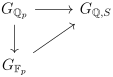
Suppose that \(X=\Spec(\ZZ[1/N])\text{.}\) Then \(\pi_1(X,x)=G_{\QQ,S}\text{,}\) where \(S\) is the set of primes dividing \(N\) and \(G_{\QQ,S}\) is the Galois group of the compositum of all number fields unramified outside \(S\text{.}\) As an example of functoriality, for any \(p\) not dividing \(N\text{,}\) there is a diagram
The general definition uses the following setup.
Definition 15.1.4.
Let \(\FEt(X)\) denote the category of finite étale schemes over \(X\text{.}\) For a geometric point \(x \in X\text{,}\) we have a base change (fiber) functor
where \(\FEt(x)\) is canonically equivalent to the category of finite sets (via the forgetful functor from schemes to sets: each object of \(\FEt(x)\) is a finite disjoint union of copies of \(x\)).
Definition 15.1.5.
We define the profinite fundamental group of the scheme \(X\) with basepoint \(x\) to be
That is, the group of natural isomorphisms of the fiber functor to itself.
Lemma 15.1.6.
If \(X = \Spec(k)\) for some field \(k\text{,}\) and \(\overline{k}\) is an algebraic closure of \(k\text{,}\) then \(\pi_1(X,\Spec(\overline{k}))\) is naturally isomorphic to \(\Gal(\overline{k}/k)\) (the absolute Galois group of \(k\)).
Proof.
See supplemental exercises.
Remark 15.1.7.
Definition 15.1.5 is an example of a Tannakian construction. The formalism of Tannakian categories typically involves categories of vector spaces (over a field of characteristic \(0\text{,}\) for technical reasons). rather than finite sets; one can get into that setup by replacing finite sets with the free vector spaces that they generate. The standard treatments of Tannakian categories are [108] and [33].
Remark 15.1.8.
The group \(\pi_1(X,x)\) was originally called the étale fundamental group; for instance, this is the terminology used in [61]. The terminology profinite fundamental group is now preferred because, when \(X\) is not normal, there are infinite-degree étale covers of schemes that should be included in the construction of the étale fundamental group, but do not contribute to the profinite fundamental group as we have defined it. One way to get the “right” definition is to replace finite étale covers with pro-étale covers in the sense of Bhatt–Scholze [10].
Example 15.1.9.
A typical example of the previous remark is the “banana”. This is the connected, but not normal, scheme given by gluing two copies of \(\PP^1\) together at \(0\) and \(\infty\text{.}\) It has an infinite étale cover which looks like a helix, and is constructed as a set as follows
That is, it is countably many copies of \(\PP^1\) glued together alternately at \(0\) and \(\infty\text{.}\) There are deck transformations of this cover given by the action of \(2\ZZ \rtimes \ZZ/2\ZZ\) on the second factor that are not included in the profinite fundamental group.
Remark 15.1.10.
The issue of infinite étale covers becomes much more acute if one passes from algebraic geometry to analytic geometry. For example, in rigid analytic geometry, the Tate elliptic curve has important infinite covers analogous to those seen in complex geometry. However, there are even more exotic examples: the Gross–Hopkins period maps give rise to infinite covers of rigid analytic projective spaces [55], [56]. In perfectoid geometry, something similar happens with Hodge–Tate period maps [19].
Remark 15.1.11.
Note that when applicable, functoriality gives Frobenius elements coming from points, although they are only defined up to conjugation in general. For example, you can take the image of Frobenius in the diagonal arrow in the diagram of Galois groups in Example 15.1.3.
Remark 15.1.12.
For a smooth proper scheme over \(\CC\text{,}\) the profinite fundamental group can be shown to be the profinite completion of the topological fundamental group of the analytification (i.e., the limit over all finite quotients equipped with the inverse limit topology). It is worth comparing this with Remark 2.0.6: for a smooth proper scheme over a number field, the fundamental group of the analytification may depend on the choice of a complex embedding of the number field, but the profinite completion of the fundamental group does not!
On a related note, the profinite fundamental group can be used to exhibit an obstruction against lifting a smooth proper variety from characteristic \(p\) to characteristic \(0\) (compare Remark 2.0.7), by virtue of being “too big to lift” in some precise sense. See [44].
Section 15.2 Lisse sheaves
Now we turn to lisse \(\overline{\QQ}_\ell\)-sheaves.
Definition 15.2.1.
Let \(\ell\) be a prime. A lisse \(\overline{\QQ}_\ell\)-sheaf “is” a finite-dimensional continuous representation
note that here we are being sloppy and dropping the basepoint in the fundamental group.
Remark 15.2.2.
Note that
and any continuous representation from a profinite group, such as \(\pi_1(X)\text{,}\) into \(\GL(r,\overline{\QQ}_\ell)\) factors through some \(\GL(r,E)\) (see supplemental exercises). Consequently, the category of lisse \(\overline{\QQ}_\ell\)-sheaves is the 2-colimit of the categories of lisse \(E\)-sheaves (meaning representations into \(\GL(r,E)\)) over all finite extensions \(E/\QQ_\ell\) within \(\overline{\QQ}_\ell\text{.}\)
Remark 15.2.3.
This is not the real definition, just a shortcut. It is not even a sheaf. We are on the wrong side of the Riemann–Hilbert correspondence.
There is an actual sheaf on some Grothendieck topology (a profinite version of the étale topology) that corresponds to a lisse \(\overline{\QQ}_\ell\)-sheaf as we have defined it. If \(\calF\) is such a sheaf, we denote the corresponding representation by \(\Lambda_\calF\text{.}\)
Definition 15.2.4.
Suppose \(X\) is a scheme of finite type over a finite field \(k\text{.}\) Then there is an \(L\)-function associated to a lisse sheaf \(\calF\) on \(X\text{,}\) given by
Here \(\Frob_x\) is the geometric Frobenius coming from the map
The geometric Frobenius is the inverse of the map \(t \mapsto t^{\#\kappa(x)}\text{,}\) which is called the arithmetic Frobenius.
As with zeta functions, we may formally rewrite this \(L\)-function as
Why do we care?
Example 15.2.5.
Let
be a morphism between smooth proper schemes of finite type over a finite field \(k\text{,}\) and \(\ell\) a prime number not dividing the characteristic of \(k\text{.}\) Then there exist lisse \(\overline{\QQ}_\ell\)-sheaves \(\calF_i\) such that for each closed point \(x \in X\text{,}\)
is the \(i\)-th factor of the zeta function
in the factorization predicted by the Weil conjectures. These \(\calF_i\) arise as higher direct images of the trivial sheaf \(\overline{\QQ}_\ell\) on \(Y\text{.}\)
Remark 15.2.6.
Deligne conjectured that every lisse \(\overline{\QQ}_\ell\)-sheaf on \(X\) “comes from geometry” in the sense that each of its irreducible subquotients is a twist (by a rank 1 sheaf) of a subquotient of something appearing in the previous example.
This conjecture was stated somewhat cautiously in [31]. It was motivated by the observation that when \(X\) is a curve, it followed from Drinfeld's geometric proof of the Langlands correspondence for the group \(\GL_2\) over the function field [37], which appeared at around the same time as [31]. For a general lisse sheaf on a curve, the conjecture follows from the extension of Drinfeld's work to \(\GL_n\) given by L. Lafforgue [81].
For \(X\) of dimension greater than 1, we do not know of any plausible approach to proving Deligne's conjecture. However, one can extract a number of concrete predictions from it, concerning both \(\ell\)-adic and \(p\)-adic Weil cohomologies, that can be verified using the case of curves as a black box. See for example the introduction to [78] and references cited therein.